Decomposition Strategies
Strategies for Decomposing a Monolith into Microservices
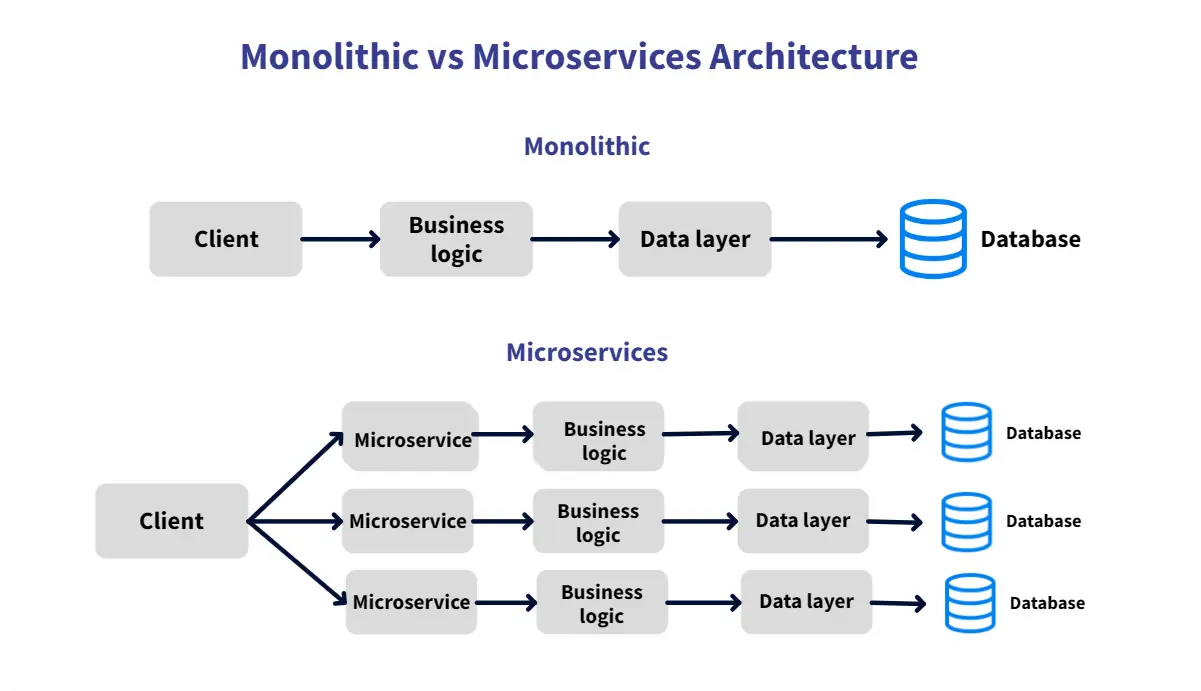
In this workshop, we analyze decomposition strategies for migrating from a monolith to microservices within a real-world context:
Food Delivery Project or Order Management System consisting of 5 services: Gateway, Kitchen, Order, Payment, Stock.
2.1 Decomposition by Business Capabilities
Splitting Based on Business Domains
Core Principle: Decompose services by business capability rather than technical layers.
Identified business capabilities:
- Order Management: Handle the entire lifecycle of an order
- Kitchen Operations: Manage food preparation and kitchen processes
- Payment Processing: Handle payments and financial operations
- Inventory Management: Manage ingredients and stock
- API Gateway: Entry point and routing for the entire system
Reasons for choosing business capability split:
- Each team can focus on a single business domain
- Easier to scale and maintain
- Business logic is not fragmented across services
Database Decomposition Strategy
Database-per-Service Pattern:
Each service owns its own MongoDB instance:
- Gateway Service
- Order Service
- Kitchen Service
- Payment Service
- Stock Service
Advantages of Database-per-Service:
- Independent schema evolution
- Service-specific performance tuning
- Strong security isolation
- Independent database scaling
2.2 Decomposition by Data Ownership
Defining Data Ownership
Principle: Each service owns and manages its own data; no shared database tables.
Data Ownership Matrix:
| Service | Data Owned | Data Accessed (Read-only) |
|---|---|---|
| Order | orders, order_items, order_statuses | inventory (from Stock), payment_status (from Payment) |
| Kitchen | kitchen_jobs, staff_schedules | orders (from Order), inventory (from Stock) |
| Payment | transactions, payment_methods | orders (from Order) |
| Stock | inventory, suppliers, stock_movements | orders (from Order) |
| Gateway | auth_tokens, rate_limits | All services (for routing) |
Data Access Strategy:
- Synchronous: gRPC calls for real-time data
- Asynchronous: RabbitMQ events for data updates
- Caching: Redis cache for frequently accessed data
Data Consistency Strategy
Eventual Consistency with Event Sourcing:
1. Order Creation Flow:
Order Service → OrderCreated Event → RabbitMQ
↓
Stock Service ← Consume Event → Update Inventory
Payment Service ← Consume Event → Create Payment Record
Kitchen Service ← Consume Event → Create Kitchen Job
2. Payment Processing Flow:
Payment Service → PaymentCompleted Event → RabbitMQ
↓
Order Service ← Consume Event → Update Order Status
Kitchen Service ← Consume Event → Start Cooking Process
3. Inventory Update Flow:
Stock Service → StockUpdated Event → RabbitMQ
↓
Order Service ← Consume Event → Check Availability
Kitchen Service ← Consume Event → Update Cooking Plan
Compensation Pattern for Failure Scenarios:
- If Stock Service fails → Rollback Order
- If Payment Service fails → Cancel Kitchen Job
- If Kitchen Service fails → Refund Payment
2.3 Decomposition by Service Dependencies
Dependency Analysis
Service Dependency Graph:
Gateway (Entry Point)
├── Order Service (Core Business)
│   ├── Stock Service (Inventory Check)
│   ├── Payment Service (Payment Processing)
│   └── Kitchen Service (Order Fulfillment)
├── Kitchen Service
│   ├── Stock Service (Ingredient Check)
│   └── Order Service (Order Details)
├── Payment Service
│   └── Order Service (Order Validation)
└── Stock Service
└── Order Service (Demand Forecasting)
Dependency-based Decomposition Strategy:
Level 1 - Independent Services (Decompose first):
- Stock Service: Fewest dependencies, can be separated first
- Payment Service: Only depends on Order Service
Level 2 - Core Business Services:
- Order Service: Core business logic, multiple dependencies
- Kitchen Service: Depends on Order and Stock
Level 3 - Gateway Service:
- Gateway Service: Separated last, once all services are stable
Dependency-based Migration Strategy
Phase 1: Foundation Services
- Extract Stock Service first (least dependencies)
- Setup MongoDB, RabbitMQ, Consul
- Implement basic CRUD operations
Phase 2: Business Services
- Extract Payment Service (dependency: Order)
- Extract Kitchen Service (dependencies: Order, Stock)
- Implement event-driven communication
Phase 3: Core Service
- Extract Order Service (core business logic)
- Implement complex workflows
- Handle cross-service transactions
Phase 4: Gateway Service
- Extract Gateway Service (depends on all services)
- Implement routing, authentication, rate limiting
Summary
Decomposition strategies for migrating the Food Delivery project from monolith to microservices:
- Business Capability Split: Decompose into 5 clear business domains
- Database-per-Service: Each service has its own MongoDB instance
- Data Ownership: Each service owns its data independently
- Eventual Consistency: Cross-service communication via RabbitMQ events
- Dependency-based Migration: Extract services from least dependent to core services
Expected outcomes:
- Independent, maintainable, and scalable services
- Data consistency ensured via event-driven architecture
- Higher team productivity through domain-focused development
- Improved system resilience with circuit breaker and compensation patterns