5.1.2. Build crypto module
I know three types of “data transformation”: Hashing, Encoding, and Encrypting. In this section, we’ll work on encoding. Why?
When querying information from a DynamoDB table, we’re going to use pagination with a start key. This start key is a JSON object containing all the field names and their values.
To make the data easier to work with, we’ll convert that JSON into Base64 and send it back to the client. The client can then use it to send further requests to fetch additional data. I’ll explain later why we need this technique.
Base64 encoding
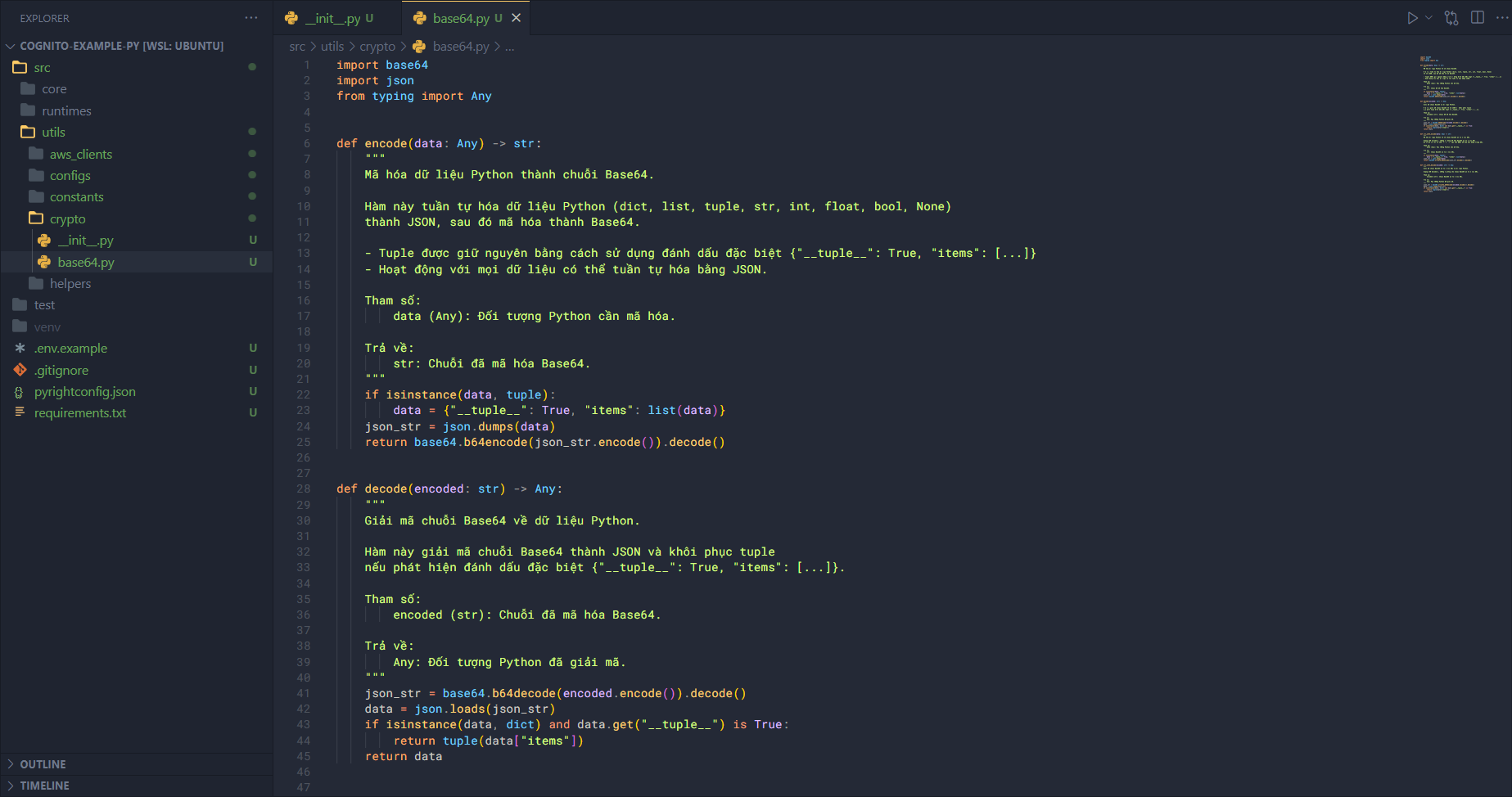
Create a new file base64.py inside the crypto/ folder and add the following code.
First, import the necessary libraries:
import base64
import json
from typing import Any
Now, add the code to encode data into Base64:
def encode(data: Any) -> str:
    """
    Mã hóa dữ liệu Python thành chuỗi Base64.

    Hàm này tuần tự hóa dữ liệu Python (dict, list, tuple, str, int, float, bool, None)
    thành JSON, sau đó mã hóa thành Base64.

    - Tuple được giữ nguyên bằng cách sử dụng đánh dấu đặc biệt {"__tuple__": True, "items": [...]}
    - Hoạt động với mọi dữ liệu có thể tuần tự hóa bằng JSON.

    Tham số:
        data (Any): Đối tượng Python cần mã hóa.

    Trả về:
        str: Chuỗi đã mã hóa Base64.
    """
    if isinstance(data, tuple):
        data = {"__tuple__": True, "items": list(data)}
    json_str = json.dumps(data)
    return base64.b64encode(json_str.encode()).decode()


def decode(encoded: str) -> Any:
    """
    Giải mã chuỗi Base64 về dữ liệu Python.

    Hàm này giải mã chuỗi Base64 thành JSON và khôi phục tuple
    nếu phát hiện đánh dấu đặc biệt {"__tuple__": True, "items": [...]}.

    Tham số:
        encoded (str): Chuỗi đã mã hóa Base64.

    Trả về:
        Any: Đối tượng Python đã giải mã.
    """
    json_str = base64.b64decode(encoded.encode()).decode()
    data = json.loads(json_str)
    if isinstance(data, dict) and data.get("__tuple__") is True:
        return tuple(data["items"])
    return data
Next, also add a Base64 encoding function that is URL-safe — this is the one we’ll actually use in this tutorial:
def url_safe_encode(data: Any) -> str:
    """
    Mã hóa dữ liệu Python thành chuỗi Base64 an toàn với URL.

    Giống như encode(), nhưng sử dụng mã hóa Base64 an toàn với URL
    để tránh các ký tự như '+' và '/' vốn cần được mã hóa khi dùng trong URL.

    Tham số:
        data (Any): Đối tượng Python cần mã hóa.

    Trả về:
        str: Chuỗi Base64 an toàn với URL.
    """
    if isinstance(data, tuple):
        data = {"__tuple__": True, "items": list(data)}
    json_str = json.dumps(data)
    return base64.urlsafe_b64encode(json_str.encode()).decode()


def url_safe_decode(encoded: str) -> Any:
    """
    Giải mã chuỗi Base64 an toàn với URL về dữ liệu Python.

    Giống như decode(), nhưng áp dụng cho chuỗi Base64 an toàn với URL.

    Tham số:
        encoded (str): Chuỗi Base64 an toàn với URL.

    Trả về:
        Any: Đối tượng Python đã giải mã.
    """
    json_str = base64.urlsafe_b64decode(encoded.encode()).decode()
    data = json.loads(json_str)
    if isinstance(data, dict) and data.get("__tuple__") is True:
        return tuple(data["items"])
    return data